Juan Diego Falls And The Angelito Trail: What Tours Actually Stop At
Juan Diego Falls and the Angelito Trail are the two places in the El Yunque area where a tour can deliver a swim without a long climb, and they sit on opposite sides of the forest, one off PR-191 and one off Road 988 near Luquillo.
Short answer
Juan Diego Falls sits at PR-191 km 9.6 with a short path to a natural pool, and the Angelito Trail is a 0.4 km easy walk on Road 988 down to Las Damas Pool on the Río Mameyes. Both list swimming, both carry flash-flood warnings, and neither requires a reservation. Entry to the corridor is free, 8:00 a.m. to 5:00 p.m.
What Are Juan Diego Falls And The Angelito Trail?
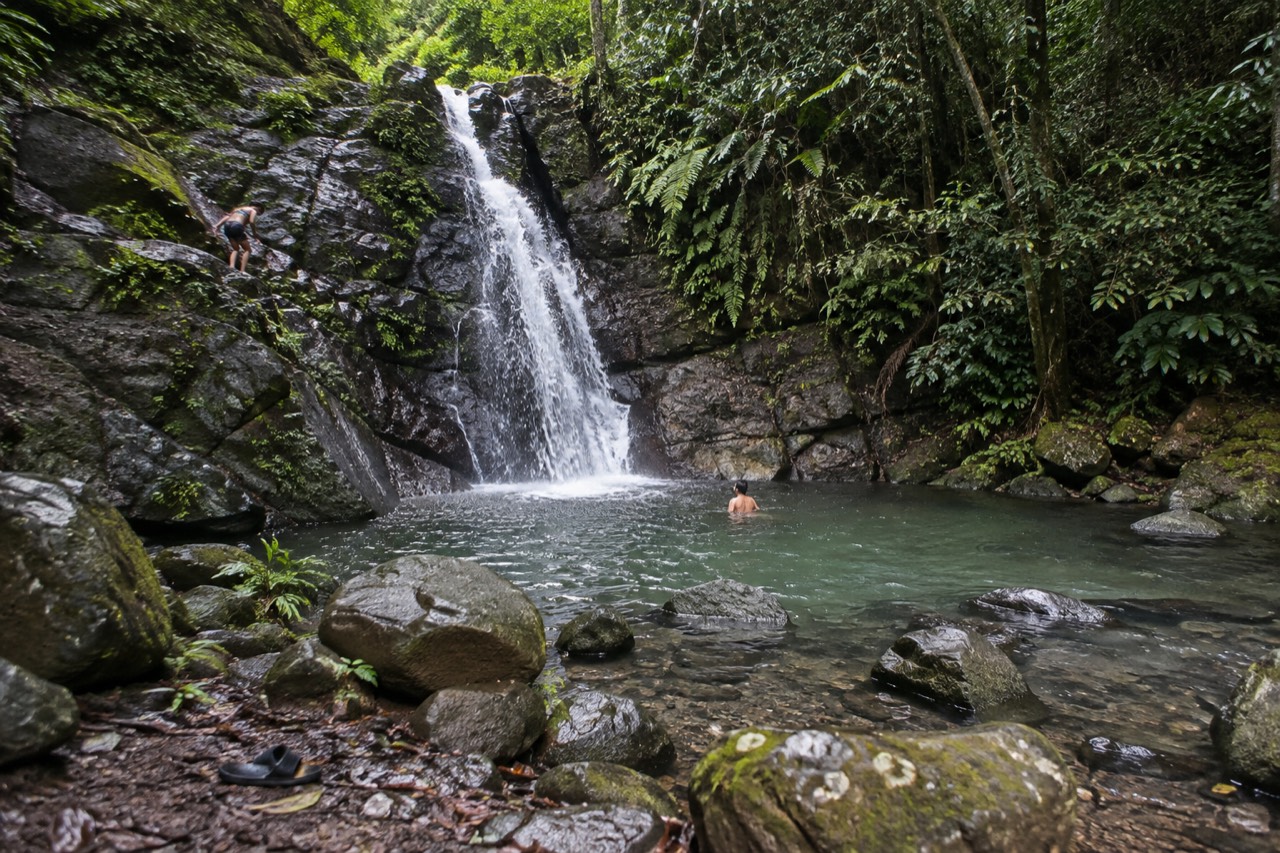
Juan Diego Falls is a roadside waterfall and natural pool at PR-191 kilometer 9.6 on the Río Grande side of El Yunque National Forest, reached by a short path, while the Angelito Trail is a 0.4 km one-way walk on Road 988 near Luquillo that descends to Las Damas Pool on the Río Mameyes. Together they are the forest's two easiest water stops. They exist on opposite flanks of the same mountain, and a visitor who understands that geography can plan a day that touches both without backtracking much.
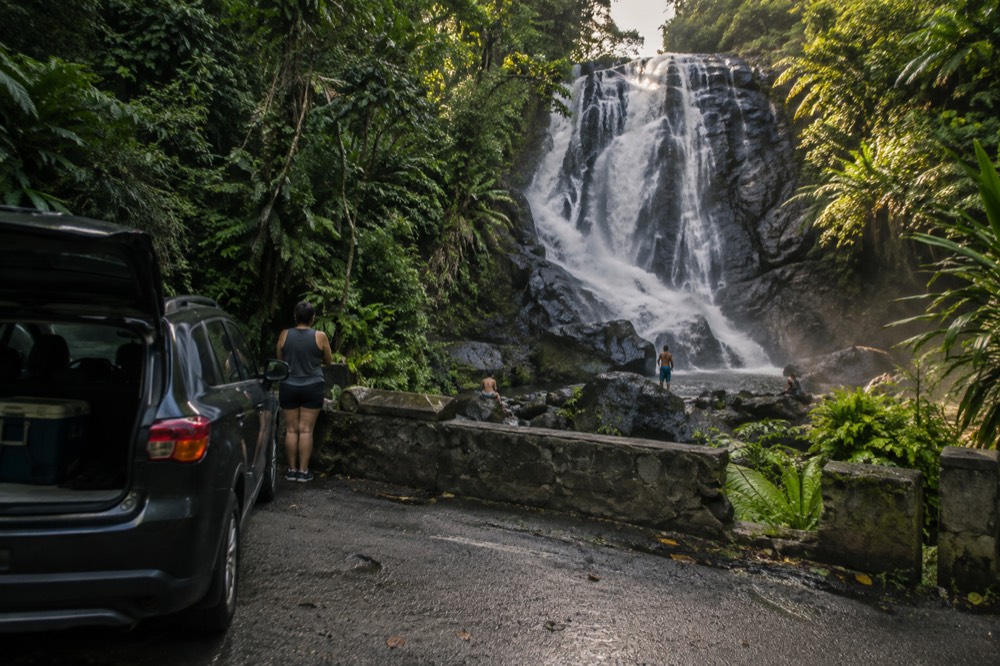
The two sites fill the same role in a tour itinerary: they are what an operator substitutes when a guest wants water without a serious hike. The Forest Service describes Juan Diego as "a short path to a natural pool along Juan Diego Creek with a beautiful waterfall that you can wade into," and it lists swimming among the site's water activities. The official Juan Diego page also notes that several natural resource restoration projects repaired ground cover inside the Wilderness designated area there, so staying on the trail matters.
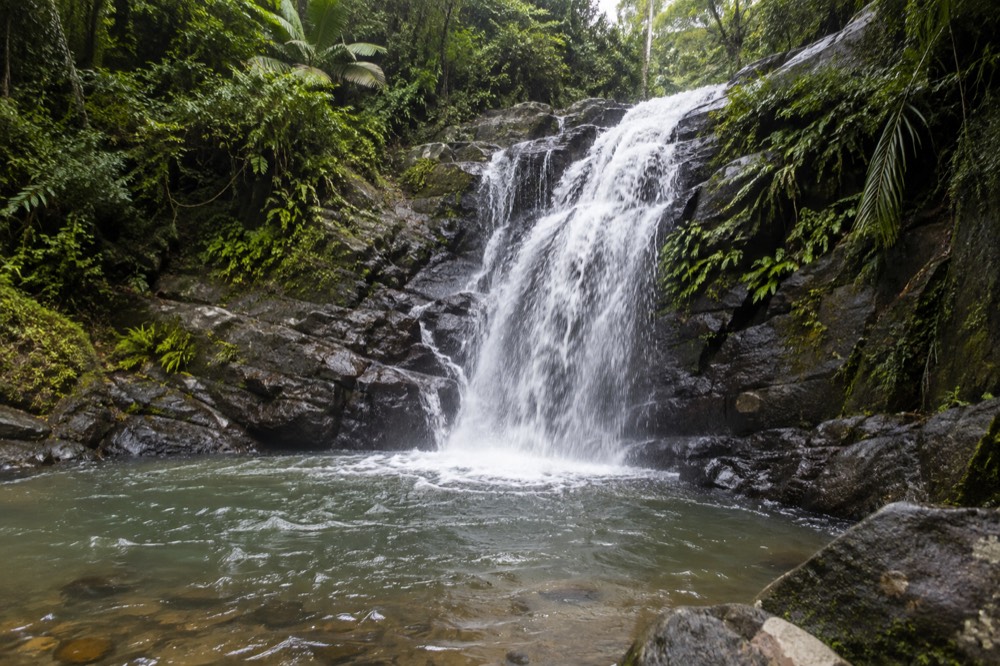
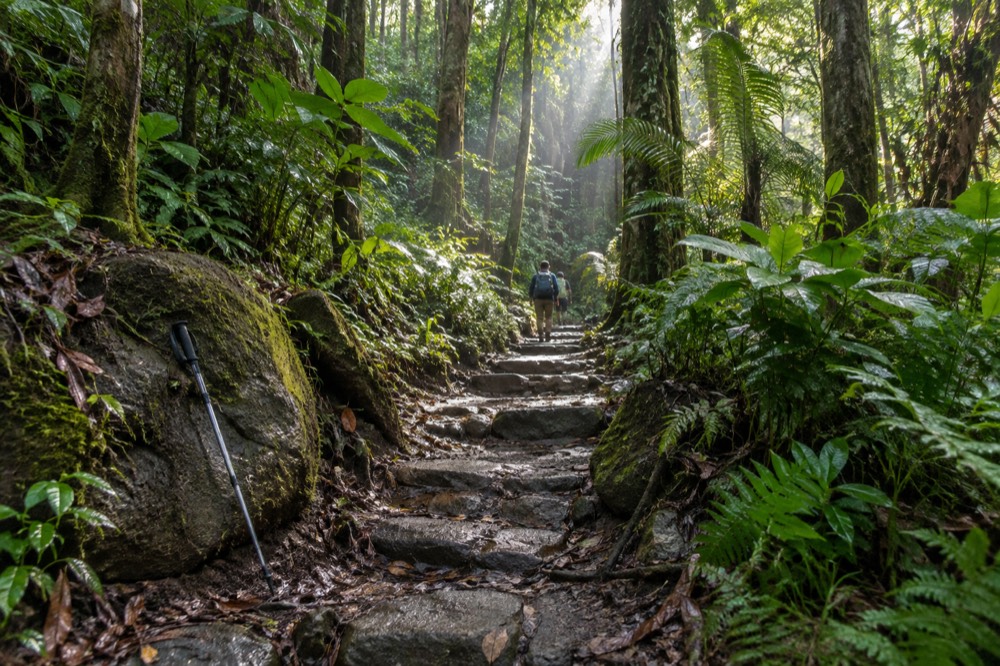
Angelito, meanwhile, is the family pick. The Forest Service calls it a short trail that "descends through Tabonuco trees in the lower montane forest to the federally designated 'Wild and Scenic River,' the Río Mameyes," and describes Las Damas Pool as one of the favorite swimming spots the trail leads to. At 132 feet of elevation change over 0.4 km, it is rated Easy. The Angelito Trail page carries the same flash-flood caution as every riverside site in the forest, which we come to below.
Neither stop requires a reservation. Entrance to the PR-191 North recreational corridor is free, with no booking of any kind, and the corridor is open 8:00 a.m. to 5:00 p.m. The Luquillo entrance on Road 988 is likewise listed as not requiring a reservation. If you have read older travel content insisting on a timed-entry permit, that system is gone; the only thing sold in the forest today is the $8 El Portal visitor center ticket, which is a separate building, not a gate.
| Juan Diego Falls | Angelito Trail | |
|---|---|---|
| Location | PR-191, km 9.6, Río Grande side | Road 988, km 3.6, Luquillo side |
| Walk to water | Short path to a natural pool | 0.4 km one way, rated Easy |
| Elevation at site | 483 m | Trail drops 132 ft / 40 m to the river |
| Swimming | Listed by the Forest Service | Listed by the Forest Service |
| Parking limit | 30 minutes maximum | Standard designated parking |
| Reservation needed | No | No |
That table is the whole decision in miniature. Juan Diego is a drive-up stop on the main scenic road, built for a quick dip and a photo before the parking clock runs out. Angelito is a genuine, if short, forest walk, and it is the one that ends at a Wild and Scenic River rather than a roadside cascade.
Can You Actually Swim At These Two Spots?
Yes, both Juan Diego Falls and the Angelito Trail are on the Forest Service's own list of swimming opportunities, which is a short list in this forest: Juan Diego's pool, Angelito Trail and Las Damas Pool on the Río Mameyes, Puente Roto, Quebrada Grande, Quebrada Sonadora, the Río Espíritu Santo Observation Point and the Río Sabana Recreation Area. That may surprise readers who have heard that swimming in El Yunque is off limits, and the confusion has a specific source.
The famous swim spot, La Mina Falls, is not currently reachable: the Forest Service's trails status alert lists La Mina Trail and Big Tree Trail, both approaches to the falls, as closed. So tour itineraries have shifted to the water sites that are open, and Juan Diego and the Río Mameyes are the two most tour-friendly of them. If a listing you are reading promises a swim at La Mina Falls, treat that as the operator's claim and check the current status before you book, because the trail situation changes with construction. The forest alerts page is the live authority.
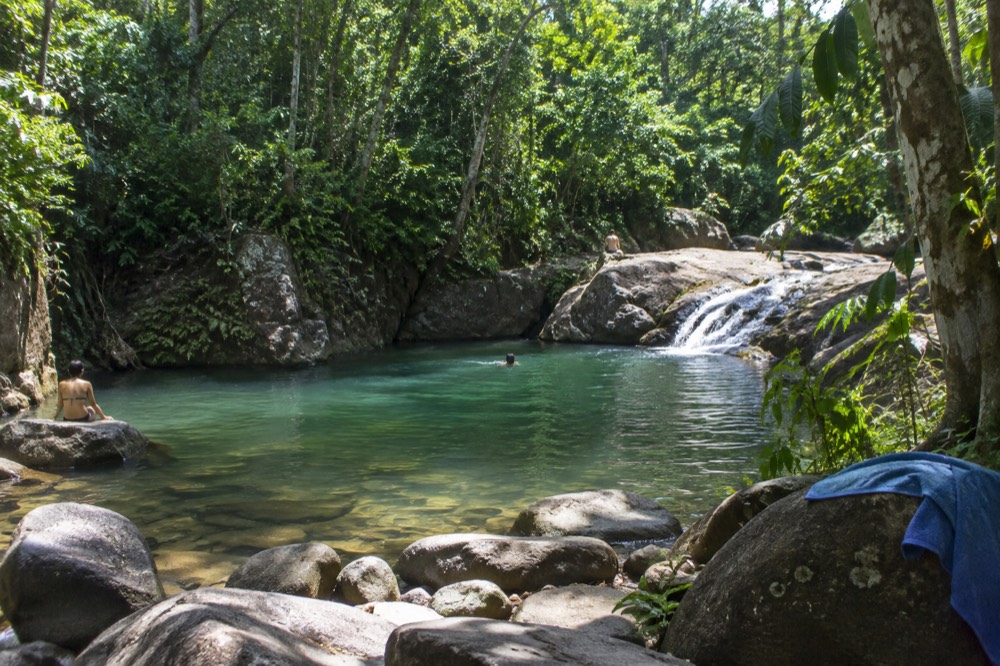
Two cautions apply at both stops, and they are not fine print. First, flash flooding: the Forest Service warns that flash floods can occur throughout the year, more frequently in the rainy months of April and May, and that a sudden surge can claim victims in less than one minute, with flood water reaching heights of 30 feet or more. Watch the weather upstream, not just over your head, and get to higher ground if water starts rising. Second, the surfaces: this is a rainforest, everything wet is mossy, and the Forest Service's own footwear advice is blunt, "wear good shoes with traction."
There is a genuinely useful planning tool for Angelito in particular. The Río Mameyes has a live USGS stream gauge, site 50065500 near Sabana, publishing real-time discharge and gage height, so you can look at the river before you get in. A river that has been quiet for days behaves differently from one running high after a storm, and the gauge makes that visible from your phone. Our longer piece on where swimming is allowed in El Yunque covers the other listed sites and the same safety framing.
One more thing worth knowing before you pick a tour around swimming: several of the waterslide tours on the Luquillo side advertise river time, rope swings and slides, and some of those spots sit outside the national forest entirely. The natural waterslides above Luquillo are on private land with no Forest Service oversight, which changes what you are buying. The two stops in this guide are inside the forest, on Forest Service land, with everything that implies for staffing and safety signage.
Which Tours Stop At Juan Diego Falls Or The Angelito Trail?
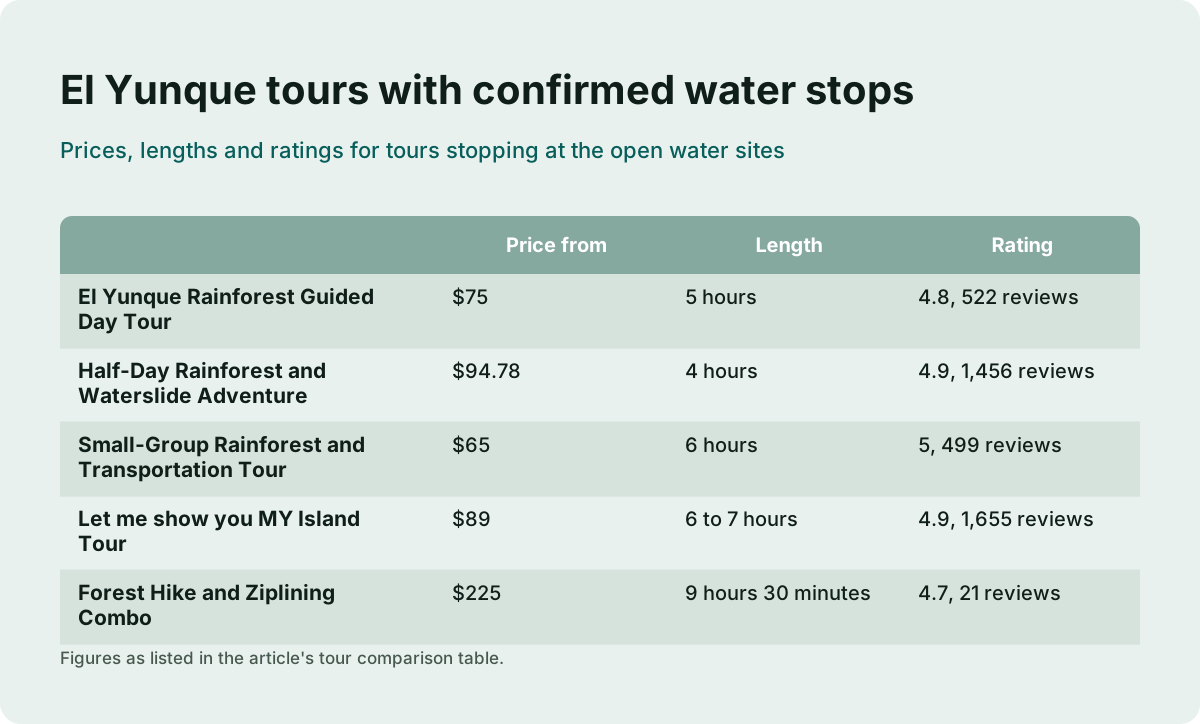
The tour most directly matched to these stops is the 5-hour El Yunque Rainforest Guided Day Tour from San Juan, from $75, rated 4.8 across 522 reviews, which confirms stops at the Río Mameyes, La Coca Falls and Yokahú Tower. For Juan Diego specifically, look at the Half-Day El Yunque Rainforest and Waterslide Adventure, from $94.78, which confirms a Río Mameyes stop, and the Small-Group El Yunque Rainforest and Transportation Luquillo Beach tour, from $65, which lists the Río Mameyes, Luquillo Beach and Las Tinajas among its confirmed stops.
Reading a listing carefully matters here, because "El Yunque" in a tour title does not mean the tour enters the PR-191 corridor. Some tours spend their water time at river spots outside the federal forest, and a guest who wanted the Forest Service sites ends up somewhere else entirely. The confirmed-stops line on a listing is the honest signal: Río Mameyes, La Coca Falls and Yokahú Tower mean the forest corridor; Las Paylas means private land outside it.
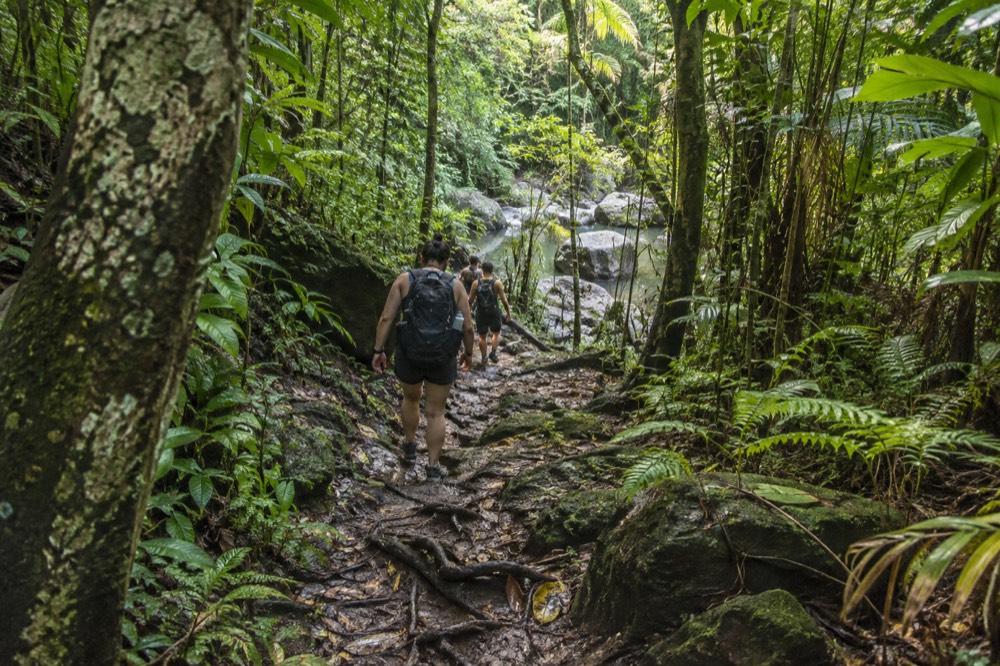
The guided day tour is the shape that fits these stops best for most travelers. It runs five hours, picks up at your hotel, and threads the corridor's three classic stops together: a river, a waterfall and a tower. Free cancellation is offered, which matters in a forest where weather can flip an itinerary in an hour. Group size is on the listing.
If you want the fuller island day instead, the "Let me show you MY Island" tour runs 6 to 7 hours from $89, rated 4.9 across 1,655 reviews, with confirmed stops at La Coca Falls, Yokahú Tower and Piñones, plus hotel pick-up. It is less of a water tour and more of a corridor-plus-coast day, but it shares the same permitted-vehicle advantage.
| Tour | Price from | Length | Rating on the listing | Confirmed water or corridor stops |
|---|---|---|---|---|
| El Yunque Rainforest Guided Day Tour | $75 | 5 hours | 4.8, 522 reviews | Río Mameyes, La Coca Falls, Yokahú Tower |
| Half-Day Rainforest and Waterslide Adventure | $94.78 | 4 hours | 4.9, 1,456 reviews | Río Mameyes |
| Small-Group Rainforest and Transportation, Luquillo Beach | $65 | 6 hours | 5, 499 reviews | Río Mameyes, Luquillo Beach, Las Tinajas |
| Let me show you MY Island Tour | $89 | 6 to 7 hours | 4.9, 1,655 reviews | La Coca Falls, Yokahú Tower, Piñones |
| Forest Hike and Ziplining Combo | $225 | 9 hours 30 minutes | 4.7, 21 reviews | Corridor hike plus zipline course |
A note on those review figures: the rating and count shown on a listing are drawn from a combined review pool for the operator's products, not a headcount of customers who took this specific tour. Treat them as a signal about the operator's overall reputation rather than a census of this itinerary.
How Hard Are The Walks To The Water?
Neither walk is hard: the Angelito Trail is 0.4 km one way with 132 feet of elevation change, rated Easy by the Forest Service, and Juan Diego is a short path from the parking area to the pool, with the site's main physical constraint being a 30-minute maximum parking time rather than the walk itself. If you can manage a stroll on uneven ground, you can manage both. What you cannot do is linger at Juan Diego, because the parking limit is enforced and the site's own page cites limited capacity.
That 30-minute cap shapes how tours use the stop. A self-driver who arrives at Juan Diego at midday is working against a clock that starts when the car stops, and on a busy day the designated spaces fill early. A tour van with a legal drop-off sidesteps the parking squeeze entirely, which is one of the quiet reasons these stops work better on an itinerary than solo. More of these guides are collected on El Yunque National Forest Tours.
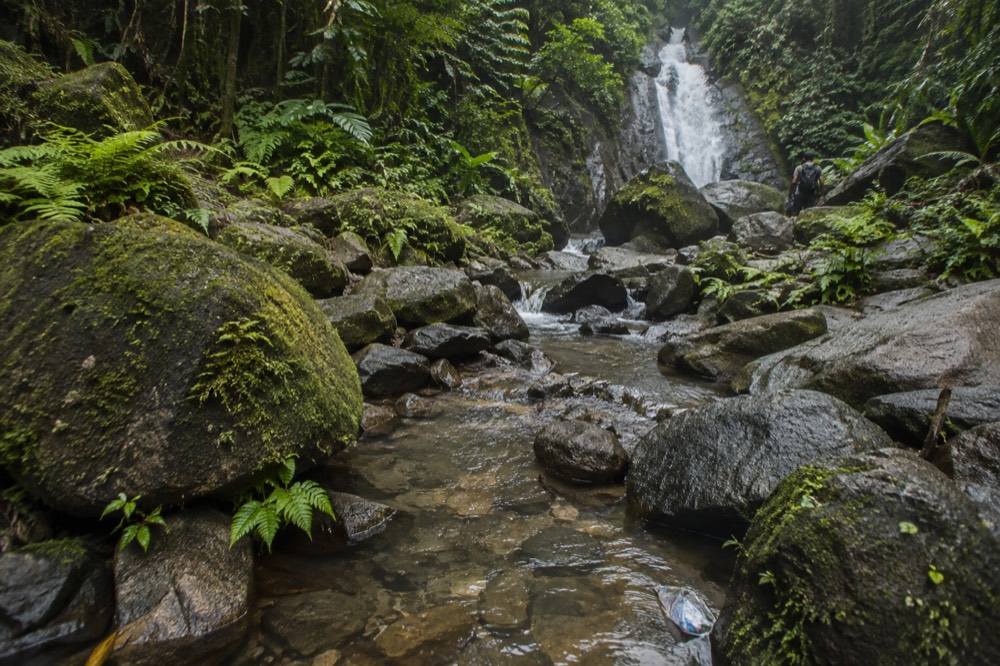
For context, these are the gentle end of this forest's walking range. La Mina Trail, when it was open, ran 0.7 miles with 492 feet of elevation change and was rated Challenging for its winding concrete stairs. Mount Britton Trail is 1.3 km with 591 feet of climbing, also Challenging. Against those, Angelito's 40-meter drop over 400 meters of trail is a different category of experience, and it is the one the Forest Service itself recommends for families with younger children. Our guide to the forest's hiking trails and their real difficulty places these two walks in the full context of what else is on the mountain.
The surfaces deserve one honest paragraph. Rainforest paths are wet, mossy and root-covered, and the Forest Service repeats the same caution on riverside trails: wet surfaces are a hazard, and more so on a slope. Footwear with traction is the single most useful thing you can bring, ahead of a towel, ahead of a dry bag. The stepping stones at any pool edge are the spots where ankles turn.
What Should You Wear And Bring For A Swim Stop?
Wear shoes with real traction and quick-drying clothes, bring a towel and a dry bag, and carry more water than you think you need: the Forest Service's own preparation advice for El Yunque leads with footwear, because the forest is wet and mossy and wet slopes are the main hazard. Water shoes or strapped sandals with grip beat flip-flops decisively at both of these stops, where you will be stepping on submerged rock.
Rain is the other constant. Annual rainfall in this forest ranges from roughly 96 inches at lower elevations to over 157 inches at the higher stations, with the highest recorded annual totals at the top of the mountain. You are not planning around whether it rains, only around when. A light rain shell and a plastic bag for your phone are the practical response, and our piece on visiting El Yunque in the rain goes deeper on what stays open and what changes.
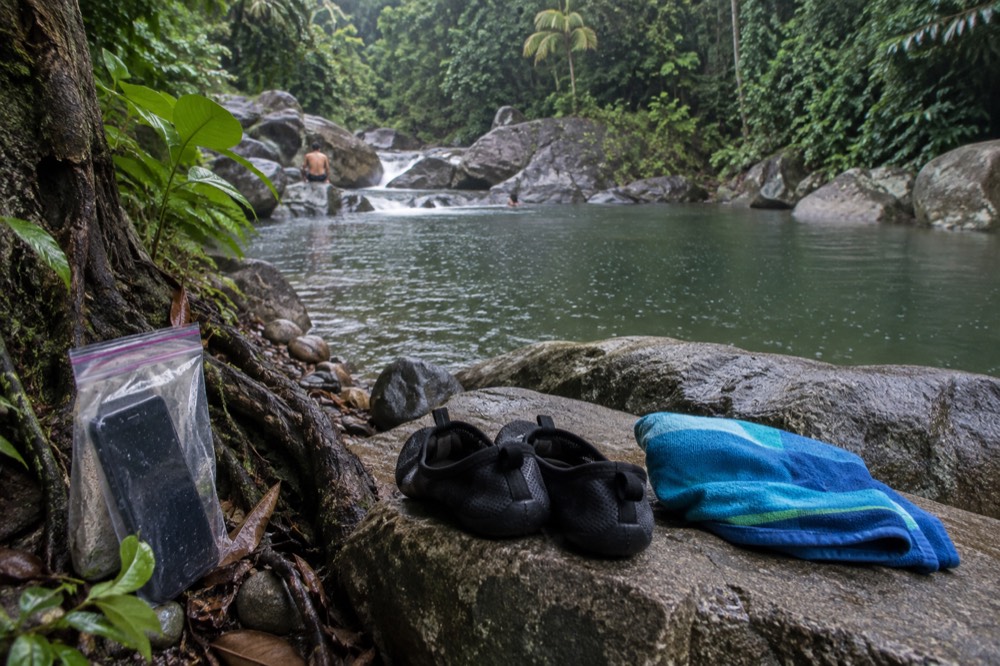
| Item | Why it matters here |
|---|---|
| Shoes with traction | Mossy rock at both pools; the Forest Service's first prep item |
| Quick-dry clothes | You will get wet, and the walk back is uphill at Angelito |
| Dry bag or zip bag | Rain and splashing are both routine |
| Towel | No services at either site |
| Water | Humidity plus walking; carry more than feels necessary |
| Insect repellent | Standard for riverside forest in Puerto Rico |
One item you can leave behind is cash for an entry fee, because there is no entry fee at either stop. The only charge inside the forest is El Portal's $8 adult ticket, and that is a visitor center you can choose to skip. Our full breakdown of tickets, reservations and what actually costs money covers the fee proposal that is still pending, including a proposed La Mina Recreation Area permit that does not exist as a charge today.
How Do You Get To Juan Diego Falls And The Angelito Trail?
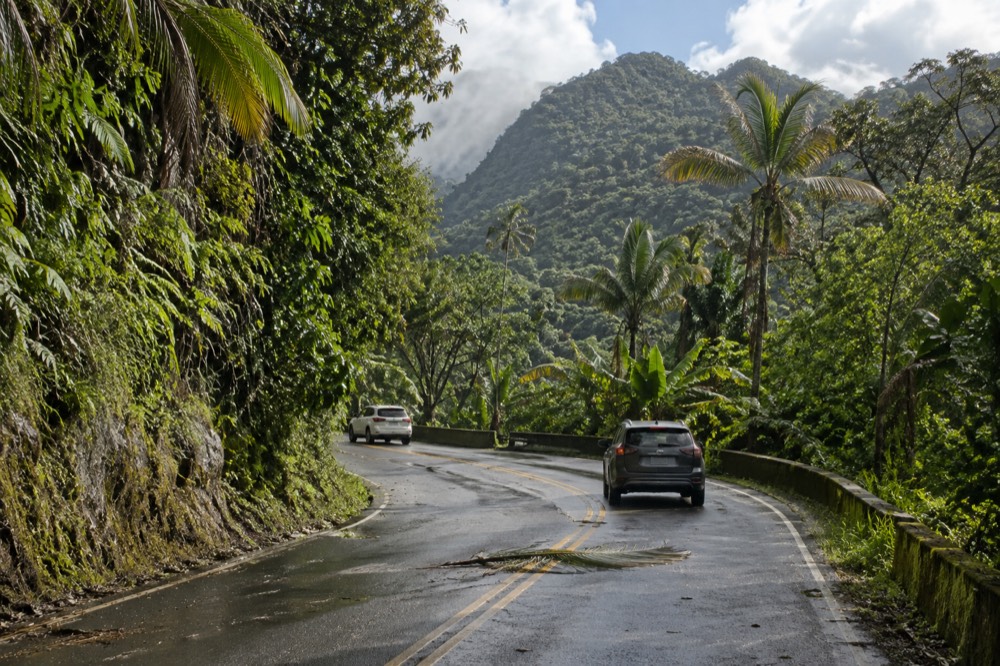
Juan Diego Falls is on PR-191 at kilometer 9.6, about 1.5 km past La Coca Falls on the main Río Grande corridor, and the Angelito Trail is on Road 988 at kilometer 3.6 on the Luquillo side; both roads are open 8:00 a.m. to 5:00 p.m. with no reservation, and parking is permitted only in designated areas. The two entrances are on different sides of the mountain, connected by Road 988, which links to PR-191 just above El Portal.
Driving yourself is entirely legal and free, but two constraints bite. First, parking: capacity on the corridor is actively managed because of parking limits, La Coca tickets violators, and Juan Diego caps you at 30 minutes. Second, getting out: the Forest Service warns that rideshare apps cannot pick up at the recreational corridor or El Portal, which has forced visitors to walk long distances to a valid pick-up point, and it also cautions that not every taxi driver holds a forest permit, so ask before hiring. The unauthorized transport alert spells this out.
That is the honest case for a tour at these two stops, and it is not about skipping a line, because there is no line to skip. A permitted tour vehicle solves parking, solves the pick-up problem, and puts a guide in the group who knows which trails are actually open on the day, which in a forest with active construction is worth more than any other single advantage. The Forest Service publishes a directory of authorized and permitted tour operators, and operators on that list are the ones holding a legal right to guide in the forest.
Road conditions deserve a sentence of their own. Road 988, the Luquillo route to Angelito, is posted with a construction warning to drive carefully, and the El Toro Scenic Byway on Road 186 carries a poor-conditions notice. Neither is a reason to stay away, but both are reasons to arrive in daylight and to prefer a driver who runs the road weekly.
When Is The Best Time Of Day To Visit Both?
Arrive early, before 10 a.m., because the corridor's parking pressure is the real crowd mechanism: designated spaces at Juan Diego are capped by a 30-minute rule, and on busy midday days the pull-offs fill, while mornings also give you the best odds of clear water and light before the afternoon cloud build-up that is normal rainforest weather. The corridor opens at 8:00 a.m. and closes at 5:00 p.m., with the Forest Service advising visitors to begin exiting at least 15 minutes before closing.
Doing both stops in one day is realistic and the order is mostly a matter of where you slept. From the San Juan side, the natural line is PR-191 up through La Coca Falls and Juan Diego, then over to Road 988 for Angelito, which drops you back toward Luquillo for the beach or the kiosks afterward. From Luquillo or Río Grande's east coast hotels, the reverse works just as well. A tour that strings the Río Mameyes together with corridor stops is effectively running this same loop with the parking solved.
Seasonally, the rainy months of April and May carry a higher flash-flood frequency, which is the one weather factor the Forest Service singles out. Rain falls year-round here, so the difference between seasons is degree, not kind. If your date is flexible, our guide to the best time to visit El Yunque works through the trade-offs, including cruise-day crowding from the San Juan piers.
For a fuller day built around these same stops, the Small-Group El Yunque Rainforest and Transportation Luquillo Beach tour runs six hours from $65, rated 5 across 499 reviews, with hotel pick-up and confirmed stops at the Río Mameyes, Luquillo Beach and Las Tinajas. It is the closest thing on the roster to the do-both-then-beach itinerary described above, handed to a driver.
Juan Diego Falls And Angelito Compared With The Other Waterfall Stops
Juan Diego and Angelito are the accessible pair, but the forest's other named water sites each carry a catch: La Mina Falls is unreachable while both its trails are closed, La Coca Falls is viewing only with no swimming listed, and Baño Grande has been closed to swimmers since 1968. Knowing which catch applies to which stop is most of what separates a planned day from a disappointed one.
La Coca Falls is the easiest to misunderstand. It is a spectacular 85-foot roadside drop at PR-191 km 8.1, but the only listed recreation opportunity there is viewing scenery. It is a photo stop, and tours treat it as one. Baño Grande, the handsome 1930s CCC-built pool at km 11.9, is explicitly posted "No swimming permitted," and has been since 1968. Baño de Oro is a restored historic site and a photo spot, a former swimming hole. The full picture, including the closure status of the La Mina approaches, is in our guide to the forest's waterfall tours and what they can actually promise.
| Water stop | Side of forest | Swimming status | The catch |
|---|---|---|---|
| Juan Diego Falls | PR-191, Río Grande | Listed, wading pool | 30-minute parking maximum |
| Angelito Trail / Las Damas Pool | Road 988, Luquillo | Listed, Río Mameyes | Flash-flood watch applies |
| La Mina Falls | PR-191, km 12.2 | Not currently reachable | Both access trails closed |
| La Coca Falls | PR-191, km 8.1 | Not listed | Viewing only, ticketed parking |
| Baño Grande | PR-191, km 11.9 | No swimming permitted | Closed to swimmers since 1968 |
| Puente Roto | Road 988, Luquillo | Listed | Road under construction, drive carefully |
This is why the two stops in this guide carry the itineraries they do. When the famous swim stop is off the table, the short-listed swimming sites inherit the demand, and Juan Diego and the Río Mameyes are the friendliest of them for a mixed group. A traveler choosing between tours should read the confirmed stops against this table before anything else: it converts a list of place names into a list of experiences.
Common Questions About Juan Diego Falls And The Angelito Trail
Can you swim at Juan Diego Falls?
Yes. The Forest Service lists swimming and wading at Juan Diego, describing a short path to a natural pool along Juan Diego Creek with a waterfall you can wade into. The same page caps parking at 30 minutes due to limited capacity, and the standard flash-flood caution applies to all forest water sites.
How long is the Angelito Trail?
The Angelito Trail is 0.4 km one way with 132 feet of elevation change, rated Easy. It descends through Tabonuco forest to the Río Mameyes, a federally designated Wild and Scenic River, ending at Las Damas Pool and other swimming spots. The walk back up is the only real effort.
Do you need a reservation for Juan Diego Falls or the Angelito Trail?
No. Entrance to the PR-191 North recreational corridor is free with no reservations required, and the Road 988 Luquillo entrance is likewise listed as not requiring a reservation. Corridor hours are 8:00 a.m. to 5:00 p.m. The only ticket sold in the forest is the $8 El Portal visitor center admission.
Which tour stops at the Río Mameyes and Juan Diego?
The El Yunque Rainforest Guided Day Tour from San Juan, from $75 for five hours, confirms stops at the Río Mameyes, La Coca Falls and Yokahú Tower with hotel pick-up. On the Luquillo side, the Small-Group Rainforest and Transportation Luquillo Beach tour from $65 also confirms the Río Mameyes along with Luquillo Beach and Las Tinajas.
Is the Angelito Trail good for kids?
The Forest Service itself describes it as a nice trail for families with younger children, thanks to the easy rating and short length. The river at the bottom has current after rain, so the flash-flood caution and adult supervision apply at the water itself, and traction shoes matter on the wet path.
Can you take an Uber or Lyft out of El Yunque?
No. The Forest Service warns that the recreational corridor and El Portal are not pick-up points for rideshare apps, and that visitors have been forced to walk long distances to reach a valid pick-up point. It advises a private or rental vehicle, a taxi with a forest permit, or an authorized tour provider.